
The Curriculum at BCA
If you require further information regarding the curriculum at BCA. Please contact Mrs McMillan by email mcmillanm@bcawarrington.org.uk
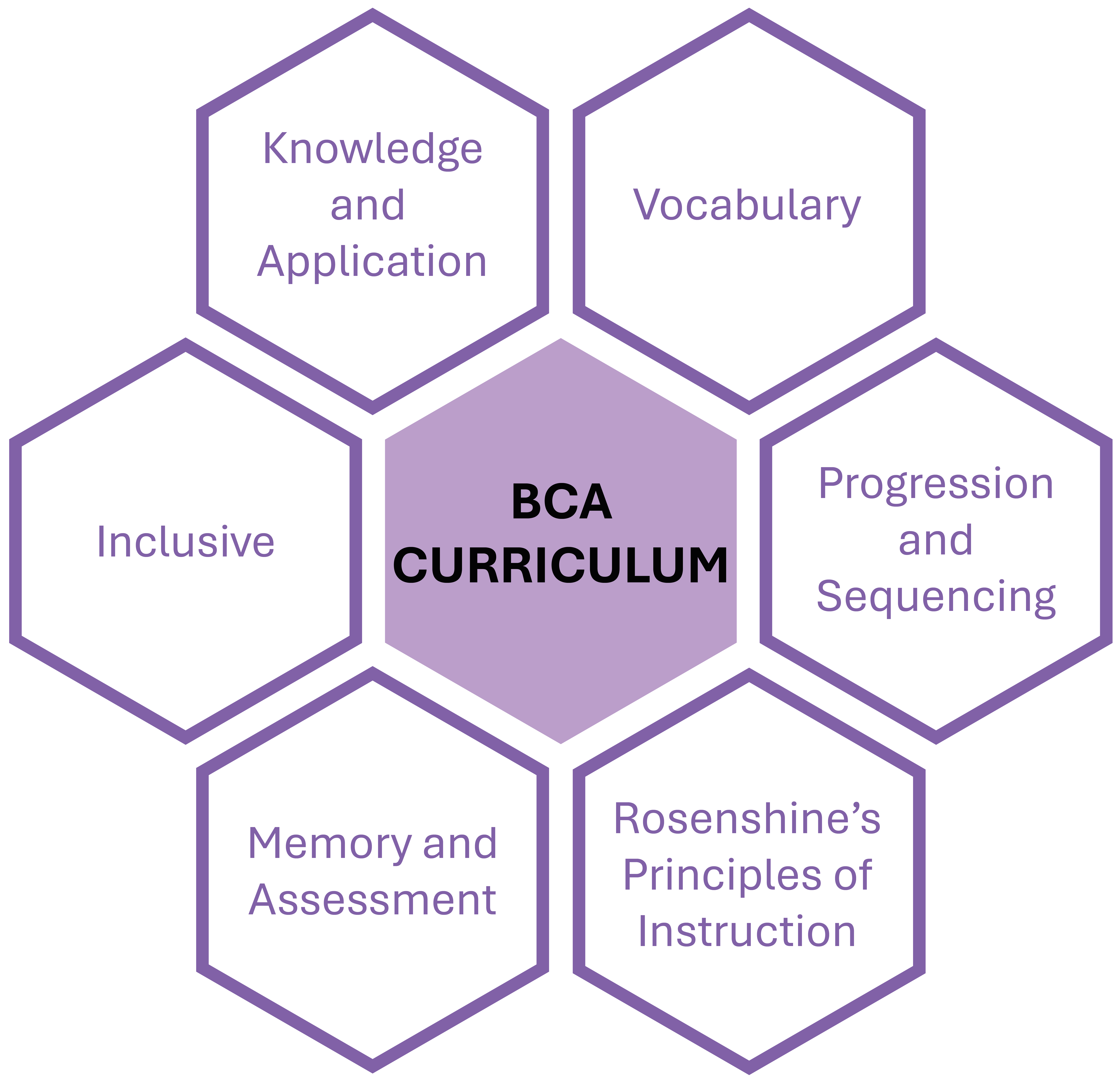
At BCA we strive to provide a curriculum which is committed to excellence for all, ensuring every student can achieve their full potential. Our curriculum is underpinned by six key principles that drive us to make sure our curriculum is inclusive, well sequenced and enriching, we aim to bring together high-quality classroom learning with meaningful experiences beyond the classroom. We aim to develop confident and knowledgeable students who are ready to thrive in school and beyond.
BCA: Six Principles of Curriculum
At Beamont Collegiate Academy our set of evidence informed ‘six-principles’ describe the features important to the design and delivery of all our subjects’ curricula.
Curriculum Subjects
Click on each subject to see what students cover across the academic year. Please note for KS4 subjects’ additional information available from the exam boards is linked.
English
Intent: Our English curriculum develops confident, articulate thinkers. It is knowledge-rich and diverse, building strong foundations in reading, writing, and oracy. Students engage with a broad literary heritage to appreciate the subject’s relevance. We prioritise analytical skill, vocabulary, and a love of reading, preparing empathetic citizens for life beyond school.
Key Stage 3
Term | Year 7 | Year 8 | Year 9 |
1 | Gender Through the Ages Resilient Voices Anthology | The Taming of the Shrew Mystery and Suspense | Morality, Power and Human Behaviour Lord of the Flies |
2 | Global Voices in Poetry Macbeth (continues) | Love and Loss Poetry Jekyll and Hyde (continues) | Poetry Through the Ages Death of a Salesman |
3 | Short Stories | Moral Panic | Dystopian Science Fiction |
Key Stage 4
Course Title: GCSE English Language
Exam Board: AQA
Specification Link: GCSE English 8700 | Specification | AQA
Term | Year 10 | Year 11 |
1 | English Language Paper 1 | English Language Paper 1 |
2 | Spoken Language Endorsement English Language Paper 2 | English Language Paper 2 |
3 | English Language Paper 1 and 2 | English Language Paper 1 and 2 |
Course Title: GCSE English Literature
Exam Board: AQA
Specification Link: GCSE English 8702 | Specification | AQA
Term | Year 10 | Year 11 |
1 | Worlds and Lives Anthology | Romeo and Juliet A Christmas Carol |
2 | A Christmas Carol
| DNA Unseen poetry Worlds and Lives Anthology |
3 | Romeo and Juliet Unseen poetry | Literature Paper 1 Literature Paper 2 |
Mathematics
Intent: We want all students to become confident, capable mathematicians by challenging the belief that only some can succeed in maths. We deliver a carefully sequenced, spiralled curriculum that introduces concepts in small, structured steps, linking new learning explicitly to prior knowledge so that students recognise that mathematical understanding is cumulative. Through instructional teaching, guided practice and opportunities for independent application, students experience success at every stage, building deep understanding and self-belief. Frequent practice of increasingly complex problems develops fluency, accuracy and quick recall, enabling students to reason and problem-solve effectively.
Key Stage 3
Term | Year 7 | Year 8 | Year 9 |
1 | Sequences Algebraic Manipulation Expressions & Equations Place Value, Ordering, and Rounding Four Operations | Ratio Proportion & Scale Algebraic Manipulation Co-ordinates & Graphs Multiply & Divide Fractions Symmetry & Reflection | Properties of Number Percentages Area & Volume Equations, Inequalities & Formulae Rates Standard Form |
2 | Graphing Data Fractions, Decimals & Percentages Directed Number Fractions & Percentages of Amounts | Area, Volume & Density Equations & Inequalities Percentages Indices Standard Form | Straight Line Graphs Ratio & Proportion Construction & Congruence Algebraic Manipulation Transformations |
3 | Perimeter & Area Speed Distance & Time Properties of Number Add & Subtract Fractions Angles & Polygons | Interpret & Represent Data Angles Probability Circles Graphs & Charts | Non-Linear Graphs Probability Pythagoras’ Theorem Trigonometry Maths & Money |
Key Stage 4
Course Title: GCSE Mathematics
Exam Board: Edexcel 9-1
Specification Link: Specification: Level 1/2 GCSE (9-1) in Mathematics
Term | Year 10 | Year 11 |
1 | Algebraic Fractions Simultaneous Equations Trigonometry Solving Equations
| Equations, Formulae & Functions Advanced Algebra Linear & Non-Linear Graphs Proportional Understanding Speed Distance Time |
2 | Angles and Bearings Area and Volume Ratio and Proportion Percentages
| Proof Vectors Revision – Complex Geometry Revision – Advanced Number Revision – Advanced Probability |
3 | Probability Statistics Indices Complex Number | GCSE Examinations |
Science
Intent: We want our curriculum to develop students’ appreciation of science and its importance in the world around them. We teach a coherent, carefully sequenced body of knowledge across biology, chemistry, and physics, showing how ideas connect and how scientific understanding has developed. Key threads run through the curriculum, building in depth over time. By the end of their journey with us, students are prepared either to pursue further science pathways or to apply what they have learned in whichever pathways they choose to follow.
Key Stage 3
Term | Year 7 | Year 8 | Year 9 |
1 | Working Scientifically The Particle Model Solubility and Separation | Diet and Digestion Chemical Reactions Energy Stores and Transfers | Electricity Generation Advanced Diet and Digestion Further Chemical Reactions |
2 | Cells and Organisation Fundamental Forces Core Chemistry | Classification and Biomechanics The Earth’s Resources Waves (Light and Sound) Respiration and Breathing (continues) | Forces and Motion Inheritance and Variation Magnetism |
3 | Reproduction Space Science Ecology | Electricity Plant Biology Forces and Extension | Atoms, Elements and Compounds Microscopy Energy and Energy Resources |
Key Stage 4
Students will study either GCSE Combined Science (Trilogy) or GCSE Biology, Chemistry and Physics.
Course Title: GCSE Combined Science (Trilogy)
Exam Board: AQA
Specification Links: GCSE Science 8464 | Specification | AQA
Term | Year 10 | Year 11 |
1 | Biology – Transport in Cells – Disease – Transport Systems (continues) Chemistry – Reactivity of Metals – Bonding – The Periodic Table (continues) Physics – Particle Model of Matter – Electrical Circuits | Biology – Genetics – Homeostasis
Chemistry – Electrochemistry – Rates (continues) Physics – Electricity in the Home – Waves – Electromagnetism |
2 | Biology – The Digestive System – Bioenergetics (continues)
Chemistry – Quantitative Chemistry – Acids and Bases – Energy Changes (continues)
Physics – Radioactivity – Forces in Action (continues) | Biology – Sustainability – Advanced Ecology
Chemistry – Organic Chemistry
Physics – Acceleration
|
3 | Biology – Defence Against Disease – The Nervous System
Chemistry – Using Resources – Chemical Analysis – Chemistry of the Atmosphere
Physics – Energy Transfer
| Biology – GCSE Examinations
Chemistry – GCSE Examinations
Physics – GCSE Examinations
|
Course Title: GCSE Biology, Chemistry and Physics
Exam Board: AQA
Specification Links:
GCSE Biology 8461 | Specification | AQA
GCSE Chemistry 8462 | Specification | AQA
GCSE Physics 8463 | Specification | AQA
Term | Year 10 | Year 11 |
1 | Biology – Transport in Cells – Disease – Transport Systems – The Digestive System (continues) Chemistry – Reactivity of Metals – Bonding – The Periodic Table (continues) Physics – Particle Model of Matter – Electrical Circuits – Radioactivity (continues) | Biology – Genetics – Homeostasis Chemistry – Electrochemistry – Rates Physics – Electromagnetism – Acceleration
|
2 | Biology – Bioenergetics – Defence Against Disease
Chemistry – Quantitative Chemistry – Acids and Bases – Energy Changes (continues)
Physics – Forces in Action – Energy Transfer (continues) | Biology – Sustainability
Chemistry – Organic Chemistry
Physics – Advanced Waves – Space Physics
|
3 | Biology – The Nervous System – Advanced Ecology
Chemistry – Using Resources – Chemical Analysis – Chemistry of the Atmosphere
Physics – Pressure in Fluids – Waves – Electricity in the Home
| Biology – GCSE Examinations
Chemistry – GCSE Examinations
Physics – GCSE Examinations
|
History
Intent: Our History curriculum aims to equip students with a secure chronological understanding of the past and the ability to think critically about how and why societies change. Through thematic enquiries into society, beliefs, leadership, power, key events and major turning points, students explore how Britain and the wider world have developed over time. We want students to question evidence, form justified conclusions, and understand the diverse experiences that have shaped the modern world. Above all, our intent is to develop knowledgeable, curious and reflective young historians who can make meaningful connections between past and present.
Key Stage 3
Term | Year 7 | Year 8 | Year 9 |
1 | Migration Norman Conquest | Stewarts British Empire | Types of Government Impact of World War Two |
2 | Medieval Monarchs Disease | Industrial Revolution Women’s Rights | Holocaust Middle East |
3 | Turning point – Black Death Reformation | World War One Treaty of Versailles | Ireland |
Key Stage 4
Course Title: GCSE History
Exam Board: Edexcel
Specification Link: Edexcel GCSE History (2016) | Pearson qualifications
Term | Year 10 | Year 11 |
1 | Paper 1: Medicine through time, Medieval 1250 – 1500, Renaissance 1500 – 1700 Paper 2: Elizabeth: Queen, government, and religion 1558 – 1569 | Paper 2: American West: The Impact of Migration on Native Americans & Gov’t Policy Paper 3: Germany: Hitler’s Rise to Power, 1918-1933 and the creation of a dictatorship 1933-34 |
2 | Paper 2: American West, Background and Migration West, 1835 – 1895 Paper 3: Weimar and Nazi Germany 1918 – 39, Weimar Germany 1918 – 1929 | Paper 1: Historic Environment: The British Sector of the Western Front 1914-18 (Medicine) Paper 2 Elizabeth: Life in Elizabethan England 1558-1588 |
3 | Paper 1: Medicine through time, Medicine in the 18th and 19th century, Modern medicine 1900 to present day Paper 2: Elizabeth: Challenges at home and abroad 1569 – 1588 | Paper 2: American West: The rise and fall of the cattle industry & law and order Paper 3: Germany: Controlling Nazi Germany (police state, (propaganda & opposition) and life in Nazi Germany GCSE Examinations |
Geography
Intent: We want to help develop the next generation of global citizens. These young people should understand the challenges and opportunities in today’s world, know the science behind how our planet works, and respect how people and nature affect each other. We aim to encourage a generation with the knowledge and confidence to ask and answer questions about why the world is the way it is – both in society and in the natural environment and to take part in building a more hopeful future for everyone.
Key Stage 3
Term | Year 7 | Year 8 | Year 9 |
1 | India | UK | Africa and USA |
2 | Warrington | World Rivers | Russia |
3 | Pacific Islands | South America | The Mediterranean |
Key Stage 4
Course Title: GCSE Geography
Exam Board: AQA
Specification Link: https://www.aqa.org.uk/subjects/geography/gcse/geography-8035/specification
Term | Year 10 | Year 11 |
1 | Changing Economic World and The Challenge of Resource Management | Physical Landscapes in the UK |
2 | The Challenge of Natural Hazards | Urban Issues and Challenges |
3 | The Living World | Geographical Applications |
Modern Foreign Languages
Intent: Our aim is to develop students’ enjoyment of languages and their appreciation of how learning another language and its culture can broaden their understanding of the world and open doors for the future. Our curriculum is built around the three pillars of communication: vocabulary, grammar, and phonics, and is carefully sequenced to ensure progression over time. We focus on high-frequency vocabulary so that students develop a personal repertoire that is genuinely useful in real communication. We aim to develop all four language skills: listening, speaking, reading and writing.
Subject: French
Key Stage 3
Term | Year 7 | Year 8 | Year 9 |
1 | School Subjects Clothes | Where I live What you can do in my Town How we spend Christmas | Jobs My Future Plans My Future Studies |
2 | Personal Information Introducing my Family Descriptions of myself and others | Music TV & Film Holidays | School Life A day in the Past Social Media Technology |
3 | Free time Weather | Future Holidays A visit to Toulouse | Food & Drink Healthy Living Festivals |
Key Stage 4
Course Title: GCSE French 8652
Exam Board: AQA
Specification Link: GCSE French 8652 | Specification | AQA
Term | Year 10 | Year 11 |
1 | Family & Relationships Marriage Free Time | Celebrations School Life Careers |
2 | Celebrity Culture My Home & Local Area Environmental Issues | Healthy Living Accidents |
3 | Holidays | GCSE Examinations |
Subject: Spanish
Key Stage 3
Term | Year 7 | Year 8 | Year 9 |
1 | School Subjects Clothes | Where I live What you can do in my Town How we spend Christmas | Jobs My Future Plans My Future Studies |
2 | Personal Information My Family and I Physical appearance Personal Characteristics | Music TV Cinema Holidays | School Life A day in the Past Technology Social Media |
3 | Free time
| Future Holidays
| Food & Drink Healthy Living Festivals |
Key Stage 4
Course Title: GCSE Spanish 8692
Exam Board: AQA
Specification Link: GCSE Spanish 8692 | Specification | AQA
Term | Year 10 | Year 11 |
1 | Family & Relationships Relationships Marriage Free Time | Celebrations School Life Careers |
2 | Celebrity Culture My Home & Local Area Environmental Issues | Healthy Living Accidents |
3 | Holidays | GCSE Examinations |
Physical Education
Intent: Our Physical Education curriculum is designed to foster a positive, lifelong relationship with physical activity, sport, and fitness. We aim to provide all pupils with the skills, confidence, motivation, and knowledge they need to engage in a healthy, active lifestyle both within school and beyond. We are committed to equipping pupils with the capacity to pursue sport and fitness in a manner that suits their aspirations, whether recreationally for enjoyment and personal health, or as a potential pathway into further study, training or a career within the sporting and fitness industries.
Key Stage 3
Activity Type | Year 7 | Year 8 | Year 9 |
1 | Base lining Invasion Game 1 Fitness Net Game | Invasion Game 1 Orienteering Fitness Net Game 1 | Invasion Game 1 Leadership Net Games 1 |
2 | Gymnastics Invasion Game 2 Athletics 1 Orienteering | Gymnastics Invasion Game 2 Net Game 2 Leadership | Net Games 2 Invasion Game 2 Fitness Testing |
3 | Athletics 2 Striking and fielding Invasion Game 3 Optional Trial Activity | Invasion Game 3 Athletics Striking and Fielding Optional Trial Activity | Invasion Game 3 Athletics Striking and fielding |
Note: Y7 & Y8: 4 activities per term. Y9: 3 activities per term. The order of the activities will rotate.
Key Stage 4
Course Title: Core PE
Term | Year 10 | Year 11 |
1 | Net games Invasion Games | Option One Invasion or Net Game Fitness or Net Game |
2 | Fitness Invasion Game 2 or Net Game 2 | Option Two Invasion or Net Game Fitness or Net Game |
3 | Striking and Fielding Athletic | Commencement of Exam Season |
Note: Y10 Lessons: Consolidation and Leadership, Y11 Lessons: Variety of Competition
Course Title: Sports Science
Exam Board: OCR
Specification Link: https://www.ocr.org.uk/qualifications/cambridge-nationals/sport-science-level-1-2-j828/
Term | Year 10 | Year 11 |
1 | 10 Components of Fitness and Appropriate Fitness Test(s): Speed-30m Sprint Strength-Hand Grip Dynamometer Aerobic Endurance-Cooper & MSFT Muscular Endurance-Sit Up and Press Up Flexibility-Sit and Reach Reaction Time-Ruler Drop Co-ordination-Anderson Wall Throw Agility-Illinois Agility Test Power-Standing Long and Vertical Jump Balance-Stork Balance | Scenario: Produced by exam board. Application of previous learning and knowledge to a given sports performer.
Sports Technology: Short term effects of exercise on the cardio-respiratory and musculoskeletal system. Long term effect of exercise on the cardio-respiratory and musculoskeletal system.
|
2 | Designing Personal Fitness Test (2) Principles of Training Aerobic and Anaerobic Exercise Methods of Training SMART Targets
| Theory Preparation for External Exam: Intrinsic Factors Extrinsic Factors Preparation and Recovery from Exercise Acute and Chronic Injuries EAP/SALTAPS/DRABC/RP Therapies Medical Conditions |
3 | Training Programme: Planning a Personalised Fitness Programme Completion of the Planned Programme Evaluation of the Planned Programme
| Exam Season
|
Art & Design
Intent: The BCA Art & Design curriculum aims to inspire and challenge students as they develop creative confidence, technical skill, and critical understanding. Students begin by experimenting with a wide range of materials and techniques, learning to express ideas visually. As they progress, they refine their skills and deepen their understanding of how art, craft, and design reflect and influence culture and society. Through analysis and personal exploration, students learn to think independently, make informed creative choices, and produce original, meaningful work.
Key Stage 3
Term | Year 7 | Year 8 | Year 9 |
1 | Drawing Skills and Observation | Colour through Architecture | Identity Illustration |
2 | Pop Art | Paper Manipulation | Identity Portraits |
3 | Portraits | Natural Forms | Journeys |
Key Stage 4
At KS4 students may study GCSE Art Design/ GCSE Textiles.
Course Title: GCSE Art & Design
Exam Board: AQA
Specification Link: GCSE Art and Design 8201 | Specification | AQA
Term | Year 10 | Year 11 |
1 | Component 1 Africa: Research and Painting Exploration
| Component 1 Close Up: Developments Coursework Completion |
2 | Component 1 Africa: Design and 3D Development | Component 2 Exam Preparation |
3 | Component 1 Close Up: Observational Drawing | Component 1/2 Coursework Completion Exam: Externally Set Assessment |
Course Title: GCSE Textiles
Exam Board: AQA
Specification Link: GCSE Art and Design 8204 | Specification | AQA
Term | Year 10 | Year 11 |
1 | Component 1 Coast, Tea and Cake: Textile Skills Development | Component 1 Natural Forms: Textile Development Coursework Completion |
2 | Component 1 Coast, Tea and Cake: Design and 3D development | Component 2 Exam Preparation |
3 | Component 1 Natural Forms: Skills and Techniques | Component 1 /2 Coursework Completion Exam: Externally Set Assessment |
Design & Technology
Intent: Our Design and Technology curriculum inspires pupils to be creative thinkers and confident problem solvers who design and make purposeful products that meet a wide range of user needs. Through practical, engaging learning, pupils develop strong technical knowledge, apply STEM in real contexts and build resilient, resourceful attitudes. Cooking and nutrition are integral, enabling pupils to understand food origins, make informed choices and prepare healthy dishes. We encourage risk-taking, exploration and evaluation so pupils become innovative, reflective learners who value sustainability and are prepared to contribute positively to an ever-changing world.
Key Stage 3
Carousel | Year 7 | Year 8 | Year 9 |
1 10 weeks | User needs and target markets Properties and uses of plastics, timbers and manufactured boards including sustainable material choice Conducting primary & secondary research Developing design criteria and specifications Generating, modelling and communicating ideas | Selecting and using appropriate tools, equipment and materials Accurate marking, measuring and finishing Properties and applications of modern, smart and sustainable materials Scale of production and industrial manufacturing Quality control to reduce defects and minimise material waste | New and emerging technologies and their sustainability impact Architecture and built environment design Civil engineering and structural principles Structural forces, loads and stability CAD for modelling, testing and communicating solutions |
2 10 weeks | Introduction to mechanical systems (levers, linkages, cams, gears) Working safely with tools and machinery Designing for a user or client Making a functional timber-based product | Cultural influences in design (e.g., Arabic patterns) Use of CAD/CAM and modern manufacturing Designing for batch and mass production Understanding and applying laser-cutting processes | Designing inclusive products using assistive technologies Electrical and electronic systems (inputs, processes, outputs) Communicating ideas using annotated sketches, 3D modelling and digital tools Iterative design: testing and refinement |
3 10 weeks | Healthy Eating Guidelines
Sustainable and Seasonal Food Choices
Inclusive Dietary Needs and Safe Preparation and Cooking Practices | Nutrition and Healthy Eating Principles
Understanding Food Labels and Dietary Choices
Applying Nutritional Knowledge in Practical Cooking | Understanding Malnutrition and Its Health Impacts
Practical Cooking Skills and Safe Food Preparation
Applying Nutrition Knowledge to Meal Planning and Healthy Choices |
4 10 weeks | Sustainable Food Choices and Environmental Impact
Healthy Eating and Nutritional Balance
Practical Cooking Skills and Ethical Ingredient Use
| Food Origins and Production Processes
Environmental Impact and Sustainable Choices
Practical Growing Skills and Informed Meal Planning
| Nutrition Needs Across Life Stages
Practical Cooking and Food Preparation Skills
Meal Planning, Labelling Awareness and Healthy Choices
|
Note: D&T operates on a carousel system with all aspects covered across the years.
Computing
Intent: Here at BCA computing we aim to create students that are passionate, engaged and curious about the computing and technological landscape in which we currently find ourselves. As well as our students continually building up their digital literacy, they will move though KS3 gaining both practical mastery and an understanding of the difference between IT and Computer Science. We hope this mix helps them find the aspect that really inspires and challenges them, to ignite a thirst for transition into a specialist area in KS4, with a view to progression to the diverse, exciting and ever-changing world of computing and technological careers.
Key Stage 3
Term | Year 7 | Year 8 | Year 9 |
1 | Digital environment and digital literacy E-portfolio Creation E-safety Poster creation Stop frame animation | The History of computing Encryption Logic and problem solving Boolean Logic Web coding Modern impact of technology | Businesses and enterprising practice Market research and analysis Packaging development Financial forecasting Business presentation |
2 | BIOS and systems architecture Fetch decode execute cycle Data representation – Binary conversions and addition Artificial intelligence | Fetch decode execute cycle – Recap and deepening Data representation – Recap and deepening Memory Cyber security inc. social engineering, hacking, DDOS attacks and global threats Defensive strategies | What is interactive and multimedia Interactive media development Static vs dynamic graphics Digital literacy Video editing |
3 | Boolean Logic Truth tables Algorithms Programming – Block based coding | Response to client brief Algorithms and programming More advanced techniques such as iteration and arrays used Text based coding | Digital literacy for transition to KS4 Word processing and formatting for productivity Spreadsheet masterclass Presentation fundamentals Enhanced use of technologies and integrating data across platforms |
Key Stage 4
Course Title: GCSE Computer Science J277
Exam Board: OCR
Specification Link: https://www.ocr.org.uk/Images/558027-specification-gcse-computer-science-j277.pdf
Term | Year 10 | Year 11 |
1 | Systems architecture Memory Secondary storage Programming immersion 1 – basic techniques and syntax Data representation – all notation work Data representation images and characters | Computational thinking concepts (decomposition, abstraction and algorithmic thinking) Iteration and trace tables More advances coding – using arrays and writing to text files Robustness, defensive design and maintainability Boolean Logic IDEs and facilities of languages |
2 | Data representation Images and characters – Sound & compression Networks (scale / hardware / factors / models / topologies / modes of connection) Programming immersion 2 – Increased use of more advanced techniques and syntax to produce extended code / more real world utility Networks (The internet & DNS / Layers & protocols / IP and mac addressing) IT security – Forms of attack and prevention methods | Component 1 recap pre-PPE (systems architecture, memory, storage, data rep, networks and IT security) Component 2 recap pre-PPE (All aside from SQL) SQL taught and practiced for first time Post-PPE both components 1 and 2 will be run through again, with focussed attention on areas of weakness. This will be continuously supplemented with programming to develop competence and independence |
3 | System software Ethical, legal, environmental issues – prep for 8 marker Programming immersion 3 – Increased focus on independence Component 2 supplementary content to programming and algorithms – Data types / test types and stages / error types Flowcharts Searching and sorting algorithms | Final prep and revision for both component 1 and component 2 exams |
Religious Studies
Religious Education is provided for all pupils, and is inclusive and broad minded.
Parents have the right to withdraw pupils from RE. If you wish to do this, make an appointment with Ms Sarah Tickle (RE Subject Leader).
The school does not support selective withdrawal from RE but will supervise pupils at these times, although not to provide additional teaching or to incur extra cost.
Intent: The aim of the RS curriculum at BCA is to give students a grounding in the major faiths of their local community and the UK. A sound knowledge of Theology, Ethics and Philosophy will allow students to think critically about the world in which they live, be tolerant and understanding and thus be empathetic members of society. We would hope that the curriculum is engaging and challenging in such a way that a curiosity about the beliefs and lives of others is fostered and developed, as well as encouraging reflection on students’ own beliefs and spirituality and their place in the world.
Key Stage 3
Term | Year 7 | Year 8 | Year 9 |
1 | How do we talk about religion? – An introduction to philosophical language and the 7 Dimensions of Religion | Buddhism Sikhi | Ethics Judaism |
2 | How do we talk about religion? – An introduction to philosophical language and the 7 Dimensions of Religion (continued) Philosophy | Sikhi Who was Jesus? (continued) | Judaism Christianity |
3 | Hinduism The Bible – structure, impact and legacy | The Problem of Evil | Islam |
Key Stage 4
Course Title: GCSE Religious Studies
Exam Board: Edexcel/Pearson
Specification Link: Edexcel GCSE (9-1) Religious Studies B: Specification Issue 2
Term | Year 10 | Year 11 |
1 | Christian Beliefs and Practices (Paper 1 – Questions 1 and 3) | Crime and Punishment (Paper 2 – Question 3) Matters of Life and Death (Paper 1 – Question 4) |
2 | Christian Beliefs and Practices (Paper 1 – Questions 1 and 3) Muslim Beliefs and Practices (Paper 1 – Questions 1 and 3) | Matters of Life and Death (Paper 1 – Question 4) Peace and Conflict (Paper 2 – Question 4) |
3 | Muslim Beliefs and Practices (Paper 1 – Questions 1 and 3) | Marriage and the Family (Paper 1 – Question 2) |
Music
Intent: Our KS3 Music curriculum aims to inspire, challenge, and empower all students to become confident, creative, and reflective musicians. Through a broad and engaging programme of study, we nurture students’ musical skills, cultural understanding, and personal expression, ensuring they develop a lifelong appreciation for music in its many forms.
Key Stage 3
Term | Year 7 | Year 8 | Year 9 |
1 | The Elements of Music Rhythm and Metre | West African Drumming | Ensemble Performance |
2 | Ukulele Performance | Keyboard Performance | Film Music |
3 | Keyboard Performance | The 12 Bar Blues | Popular Music |
Key Stage 4
Course Title: BTEC Tech Award Level 1/2 in Music Practice
Exam Board: Pearson
Specification Link: https://qualifications.pearson.com/en/qualifications/btec-tech-awards/music-practice-2022.html
Term | Year 10 | Year 11 |
1 | Component 1: Exploring Music Products and Styles | Component 3: Introduction to Responding to a Brief |
2 | Component 2: Music Skills Development | Component 3: Introduction to Responding to a Brief |
3 | Developing Skills and Techniques in the Music: Response to a Brief | Component 3: Introduction to Responding to a Brief |
Please click here to view the BCA DFE Music Development Plan
Expressive Arts
Intent: We want our curriculum to develop students’ appreciation of the performing arts and its significance in culture, society, and everyday life. We teach a progression of skills and knowledge across dance and drama focusing on performance techniques and creative processes. Key strands such as performance, composition, form, style and technique as well as analysis, build in depth over time. By the end of their journey with us, students are equipped with the skills to continue into further performing arts pathways or to apply the transferable qualities they have gained to whichever futures they choose.
Key Stage 3
Term | Year 7 | Year 8 | Year 9 |
1 | Grimm Tales Matilda | Musicals Shakespeare | World Dance Verbatim |
2 | Skills & Styles of Theatre 1920s Dance | 1950s Dance Curious Incident | Musical Theatre DNA |
3 | Physical Theatre Oliver Twist | Street Dance Historical Figures | Jamie Stage Craft |
Key Stage 4
At KS4 students may study BTEC Drama/ BTEC Dance.
Course Title: BTEC Drama
Exam Board: Pearson
Specification Link: BTEC in Performing Arts | Pearson qualifications
Term | Year 10 | Year 11 |
1 | Component 1: Exploring the performing arts | Choreography and technical skills development |
2 | Component 2: Developing skills and techniques in performing arts | Component 3: Responding to a brief
|
3 | Performance skills development | Exam Season |
Course Title: BTEC Dance
Exam Board: Pearson
Specification Link: BTEC in Performing Arts | Pearson qualifications
Term | Year 10 | Year 11 |
1 | Component 1: Exploring the performing arts | Devising and technical skills development |
2 | Component 2: Developing skills and techniques in performing arts | Component 3: Responding to a brief
|
3 | Performance skills development | Exam Season |
PSHE (Inc. Citizenship)
Intent: The PSHE curriculum is a core driver of pupils’ personal growth, wellbeing, and preparedness for life in modern Britain. It is ambitious, inclusive, and carefully sequenced, ensuring all pupils progressively develop the knowledge, skills, and attributes needed to make informed choices and succeed beyond school. The curriculum is responsive to pupils’ needs, local context, making learning relevant and impactful but aligned with established frameworks (e.g., PSHE Association guidance) and reflects statutory requirements for aspects such as Relationships and Sex Education (RSE) and Health Education. Each core theme: Health & Wellbeing, Relationship and Living in the Wider World are designed to repeat, revise, and extend year on year using a spiral curriculum approach.
Key Stage 3
Term | Year 7 | Year 8 | Year 9 |
1 | Personal values and goal-setting Relationships: Friendships, family & respect. Online & offline (healthy & unhealthy). | Personal values and goal-setting Relationships: Friendships, family & respect. Online & offline (healthy & unhealthy). | Personal values and goal-setting Relationships: Friendships, family & respect. Online & offline (healthy & unhealthy). |
2 | Relationships: Bullying, being safe online & offline, online safety (including digital citizenship) and puberty. | Relationships: Bullying, harassment, being safe online & offline, online safety (including digital citizenship). | Relationships: Bullying, online safety, harassment – including sexual, being safe online & offline (including digital citizenship). |
3 | Health and Wellbeing: Physical health, mental wellbeing, healthy lifestyles, managing risks and personal safety. | Health and Wellbeing: Physical health, mental wellbeing, healthy lifestyles, managing risks and personal safety. | Health and Wellbeing: Physical health, mental wellbeing, healthy lifestyles, managing risks and personal safety. |
Key Stage 4
Term | Year 10 | Year 11 |
1 | Personal values and goal-setting Relationships: friendships, family, respect, and diversity. | Personal values and goal-setting Living in the Wider World: Further & higher education pathways, Careers education. |
2 | Relationships: Bullying, harassment, consent and aspects of RSE education. Being safe online & offline (including digital citizenship). | Health and Wellbeing: Physical health, mental wellbeing, healthy lifestyles, managing risks and personal safety. Emphasis on exam preparation & reflection, stress, and self-care. |
3 | Relationships: Intimate and sexual relationships, including sexual health; Contraceptives & STI’s, teenage pregnancy and supportive families. | Relationships: Intimate and sexual relationships and risky behaviour. Living in the Wider world: Global Citizenship and financial education. |
Note:
- PSHE is intentionally designed to be a reactive and responsive curriculum. This means that units and lesson content may need to be adapted, amended, or reprioritised in response to emerging needs. As a result, PSHE units are not always delivered in a fixed sequence.
- Content becomes more detailed, complex, and age appropriate as pupils mature.
- Internal & external support services are promoted for all years, in all terms.
Reading Curriculum
Intent: to enrich students’ reading experiences through high-quality reading instruction that broadens vocabulary and fosters engagement with diverse topics and issues, ensuring meaningful connections across the wider curriculum.
Key Stage 3
Term | Year 7 | Year 8 | Year 9 |
1 | Identity Creativity Age | The Power of Sport Criminality Behaviour | Heroes Politics
|
2 | One World Time Law | Empowerment Philosophy Evolution | Gender Social Media
|
3 | Morality Exploration Loyalty | Journeys Leadership Perspective | Alternate worlds Aspiration |
Business Studies
Intent: The intent of our curriculum is to provide all learners with a rich, vocationally grounded understanding of the world of small businesses and entrepreneurship. Our curriculum aims to develop a secure understanding of how enterprises operate, the characteristics and motivations of entrepreneurs, and the internal and external factors that influence business success. Learners will explore real-world enterprises to understand customers, competitors, market forces and financial decision-making, enabling them to build a practical appreciation of how businesses identify opportunities and respond creatively to challenges. They will develop financial literacy, problem-solving skills, time management and the ability to innovate.
Key Stage 4
Course Title: BTEC Level 1/Level 2 Tech Award in Enterprise
Exam Board: Pearson Edexcel
Specification Link: Specification
Term | Year 10 | Year 11 |
1 | Size and features of SMEs Types of profit-making enterprises Markets, sectors, models and industries in which enterprises operate Aims and activities of enterprises Skills and characteristics of entrepreneurs Market research methods Understanding customer needs and competitor behaviour | Targeting and segmenting the market 4Ps of the marketing mix Trust, reputation and loyalty Financial documents Payment methods Revenue and costs |
2 | PEST (Political, Economic, Social, Technological) analysis SWOT (Strengths, Weaknesses, Opportunities, Threats) analysis | Financial statements Profitability and liquidity Budgeting Cash flow |
3 | Choosing ideas for a micro-enterprise Plan for a micro-enterprise Production of presentation Delivery of presentation Review of presentation | Break-even point and break-even analysis Sources of business finance |
Health & Social Care
Intent: The intent of the curriculum is to provide all learners with a broad and practical understanding of the health and social care sector, developing the knowledge, skills, and personal attributes required to succeed in further study or in future care-related careers. The curriculum is designed to engage learners through applied learning, looking at real-life context through case studies, and how different factors and life events specific to individuals provide diverse needs across different life stages.
Key Stage 4
Course Title: BTEC Level 1/Level 2 Tech Award in Health and Social Care.
Exam Board: Pearson Edexcel
Specification Link: Specification – Pearson BTEC Level 1/Level 2 Tech Award in Health and Social Care 2022
Term | Year 10 | Year 11 |
1 | Patterns of growth and development through different life stages. Different factors that affect growth and development. The impact of life events on growth and development across different life stages. Types of support available to help individuals adapt to life events. | The impact of life events on health and wellbeing. Different health indicators and the impact they have on health and wellbeing. How and why health and social care services provide a person-centred approach. Recommended actions to improve health and wellbeing. |
2 | Different health and social care services available to individuals. Suitability of the care services to meet individual needs. Barriers to accessing health and social care services. | Informal and formal support and how that helps an individual access care. Barriers to accessing health and social care services. Obstacles when accessing health and social care services. |
3 | Skills, attributes and values required by professionals working in health and social care. Obstacles when accessing health and social care services. Factors that affect health and wellbeing. | Exam Season |
Hospitality
Intent: Our curriculum develops pupils’ knowledge, practical skills and confidence to work safely, independently and creatively with food. Across two years, pupils learn about nutrition, food safety, dietary needs, menu planning and the operation of the hospitality industry, while cooking every week to a professional standard. Learning is sequenced so pupils build knowledge over time: Unit 1 theory in Year 10; Unit 2 applied assessment in early Year 11; and revision and consolidation thereafter. Weekly practical work allows pupils to apply theory directly, develop technical skills and deepen understanding through rehearsal and refinement.
Key Stage 4
Course Title: Level 1/2 Vocational Award in Hospitality and Catering (Technical Award)
Exam Board: WJEC
Specification Link: https://www.wjec.co.uk/qualifications/level-12-vocational-award-in-hospitality-and-catering/#tab_keydocuments
Term | Year 10 | Year 11 |
1 | Health and safety in hospitality and catering Food safety legislation and food-induced ill health Safe cooking & hygiene in practice | LO1: Understanding the environment and brief requirements LO2: Menu planning LO3: Time plans and technical skills |
2 | Types of hospitality and catering provision and service Employment roles and responsibilities Practical food preparation and cooking skill development | LO4: Evaluating the dishes and performance Controlled Practical Assessment Revision and exam preparation (revisiting content from Unit 1/Year 10) |
3 | Factors contributing to success in the industry Kitchen workflow and operations Meeting customer requirements Practical food preparation and cooking skill development | Deep content revision of Unit 1 Exam technique and practice papers External assessment- written paper |
Engineering (CtBE)
Intent: Our Engineering – Construction and the Built Environment curriculum is designed to inspire curiosity, build confidence and equip students with practical and industry relevant knowledge and skills for further education, apprenticeships and employment. Through study of the built environment and civil engineering students explore how structures and infrastructure are designed and constructed and gain insight into the professional and trade roles that support planning, design and construction. They develop skills in interpreting technical information, producing design drafts and models, and planning and evaluating construction tasks, while reinforcing foundations such as health and safety, sustainability and problem solving. This vocational qualification helps learners connect classroom learning with real world contexts and progress confidently within the built environment and civil engineering industry.
Key Stage 4
Course Title: Engineering – Construction and the Built Environment
Exam Board: Eduqas
Specification Link: https://www.eduqas.co.uk/qualifications/level-12-vocational-award-in-construction-and-the-built-environment/#tab_keydocuments
Term | Year 10 | Year 11 |
1 | The Sector The Built Environment Life Cycle Types of Building and Structure Technologies and Materials
| Identifying and calculating information Writing and setting success criteria Drawing plans Drawing elevations Using the language of drafting: |
2 | Identifying and calculating information Writing and setting success criteria Drawing plans Drawing elevations Using the language of drafting Drawing two dimensional (2D) plans Creating three dimensional (3D) virtual models and plans Evaluating design tasks | Drawing two dimensional (2D) plans Creating three dimensional (3D) virtual models and plans Evaluating design tasks
|
3 | Building structures and forms Sustainable construction methods Trades, employment and careers Health and safety
| Unit 1 – Exam revision topics/units: – The sector – The built environment life cycle – Types of building and structure – Technologies and materials – Building structures and forms – Sustainable construction methods – Trades, employment and careers – Health and safety
|
Interactive Media
Intent: For those who moved through the KS3 computing curriculum and loved being creative and developing digital assets and interactive websites, this is their opportunity to bring that to the next level. They will gain an insight into the interactive media sector, whilst developing a range of practical and technical skills. The grasp of interactive products beyond websites and apps, such as multimedia Kiosks, Interactive TV, e-learning platforms and AR and VR, will prepare them for the exciting modern landscape of IT and interactive media at KS4 and all the wonderful and creative careers beyond.
Key Stage 4
Course Title: NCFE Level 1/2 Technical Award in Interactive Media
Exam Board: NCFE
Specification Link: https://www.ncfe.org.uk/media/jdlbh5wg/603-7005-1-qualification-specification-version-1-3.pdf
Term | Year 10 | Year 11 |
1 | What is interactive media Types of interactive media products Features of interactive media products Intellectual property law Target Audience – Demographics and Psychographics Health and safety for the industry Ethical constraints and employment legislation of the industry | Final prep for live NEA launch – project stages with focus on research and proposal) Interleaved NEA prep with common theory topics around products, assets, features, purposes and audience NEA goes live October 1st Task 1: Complete and submit research Task 2: Complete and submit Proposal Task 3: Complete and submit Planning Task 4: Complete and submit Assets |
2 | Software packages for content development Software packages for product development Hardware and features Content creation (processes & techniques) Researching features and products from a range of themes and audiences | Task 5: Complete and submit development Task 6: Complete and submit Evaluation Resume Theory content areas 1 to 7 in prep for exam Interactive products and features Target audience Proposals Software and hardware Developing interactive products |
3 | NEA practice (stages of project) Research Proposal development Planning stages Assets gathering and development Website creation Evaluations | Promote and present interactive products Review production processes and final product Final prep & revision for exam |